Inside a federal courthouse in Oakland, California, two of the world’s richest men are locked in a legal battle that goes far beyond a billion-dollar dispute — on trial is the soul of artificial intelligence itself: who controls it, who it serves, and what happens when a founding mission collides with trillion-dollar ambition.
1. Background: How It All Started
In 2015, Elon Musk and Sam Altman co-founded OpenAI on a radical premise: build a nonprofit organization dedicated to developing artificial intelligence safely and for the benefit of all humanity. Musk contributed more than $44 million in early funding and was widely seen as the driving force behind the company’s altruistic vision.
The relationship began to deteriorate when Musk pushed for unilateral control of the organization. According to trial testimony, he wanted people to know that “he was in charge.” Altman and Brockman reportedly resisted. In 2018, Musk left the board.
What followed was the transformation Musk calls a betrayal: OpenAI gradually shifted from a pure nonprofit to a hybrid for-profit structure, secured billions from Microsoft, reached a valuation of $852 billion, and is now planning a landmark IPO — all of it, Musk argues, at the cost of its founding mission.
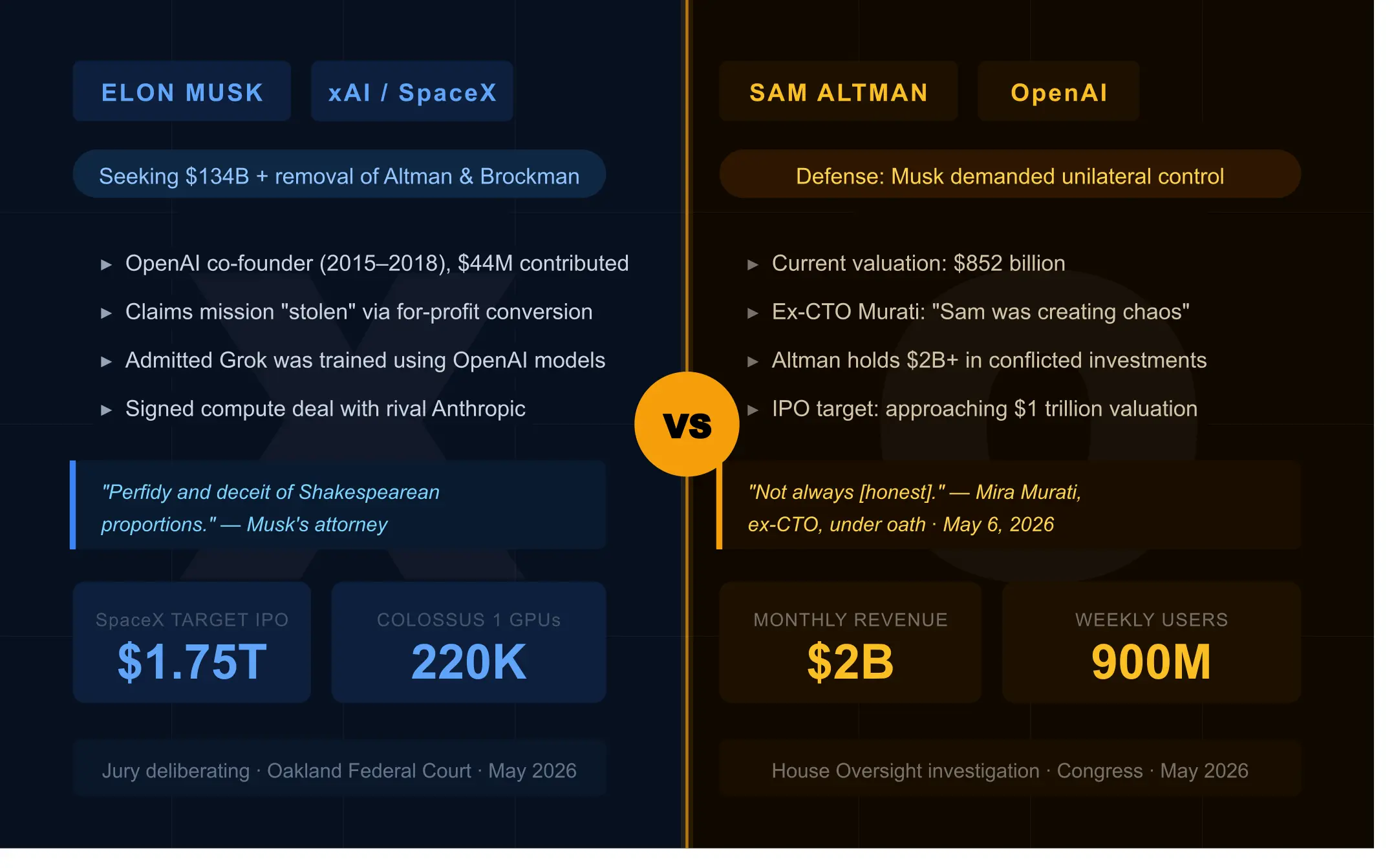
“Perfidy and deceit of Shakespearean proportions.” — Marc Toberoff, Musk’s lead attorney, in opening arguments.
2. The Trial: Numbers and Structure
Filed in 2024, the lawsuit reached federal court in Oakland in late April 2026. The defendants are Sam Altman (CEO), Greg Brockman (President), and, by extension, OpenAI and Microsoft.
Musk’s key demands include:
- Redistribution of up to $134 billion in “wrongful gains” back to OpenAI’s nonprofit arm
- Removal of Altman and Brockman from their positions
- Unwinding of the 2025 for-profit recapitalization
The nine-person jury’s verdict is advisory — the final liability decision rests with Judge Yvonne Gonzalez Rogers. After more than ten days of testimony and closing arguments on May 15, 2026, the jury entered deliberations the following week.
3. The Most Explosive Courtroom Revelations
3.1. Mira Murati: “Sam Was Creating Chaos”
Former OpenAI CTO Mira Murati — who briefly served as interim CEO after the board’s temporary ouster of Altman in November 2023 — delivered video testimony that shook the trial.
Under oath, Murati described Altman as someone who “said one thing to one person and the complete opposite to another” and was “creating chaos” at the company. She also testified that Altman misled her by falsely claiming OpenAI’s lawyers had cleared the release of a new AI model without safety board review — which, according to her, was not true.
When asked directly whether Altman was honest with her, Murati paused for a long moment before answering: “Not always.” She confirmed he had “undermined” her role as CTO and “pitted executives against one another.”
Notably, Murati said she had nonetheless pushed the board to keep Altman as CEO during the 2023 crisis — reflecting the operational dilemma the company faced.
3.2. Ilya Sutskever and the “Consistent Pattern of Lying”
OpenAI co-founder Ilya Sutskever testified that he wrote a 2023 memo to the board characterizing Altman as exhibiting a “consistent pattern of lying” that caused a loss of trust and productivity, and confirmed he had told the board that Altman was “pitting his execs against one another.”
3.3. Greg Brockman’s Journal
Musk’s attorneys used Brockman’s personal diary entries as a central piece of evidence, arguing they show that Brockman and Altman misled Musk about keeping OpenAI as a nonprofit. Brockman, however, testified that his top priority was always the company’s mission, and that it was Musk who sought unilateral control — saying “people needed to know he was in charge.”
3.4. Altman’s Conflicts of Interest
On the witness stand, Altman confirmed he owns approximately one-third of Helion Energy, a fusion energy startup valued at around $1.65 billion as of late 2025. In total, he holds more than $2 billion in companies that do business with OpenAI — including a $200 million data deal with Reddit, negotiated while he held a significant personal stake in the social media company.
These conflicts triggered a formal investigation by the House Oversight Committee, which ordered Altman to testify by May 22, 2026. Six Republican state attorneys general also called on the SEC to scrutinize OpenAI’s governance before any IPO proceeds.
3.5. Satya Nadella: “Amateur City”
Microsoft CEO Satya Nadella testified that the OpenAI board never gave him a clear reason for firing Altman in 2023, calling the episode “amateur city, as far as I’m concerned.”
3.6. The Settlement Attempt — and the Threatening Email
Behind the scenes, Musk attempted to settle with Brockman in the week before trial. When Brockman suggested both sides drop their respective claims, Musk replied: “By the end of this week, you and Sam will be the most hated men in America. If you insist, so it will be.” The email was made public by OpenAI’s lawyers.
3.7. Musk’s Grok Admission
In a revealing moment, Musk admitted in court that his own AI model Grok, built by xAI, had been trained in part by “distilling” OpenAI’s GPT models — the very company he is suing for unethical practices.
4. The OpenAI IPO: Billions on the Line
As the trial unfolds, OpenAI is moving toward one of the largest IPOs in history. The current numbers are staggering:
- Current valuation: $852 billion (after a $122 billion funding round closed in March 2026)
- Monthly revenue: $2 billion
- Weekly active ChatGPT users: 900 million
- Net loss in 2025: $44 billion
- Projected infrastructure spending over 5 years: $1.15 trillion
CFO Sarah Friar has already stated the company would not be ready to go public in 2026. Analysts now point to mid-to-late 2027 as the most realistic timeline, especially given the congressional investigations and the ongoing lawsuit. If Musk prevails and the recapitalization is unwound, the IPO could be blocked entirely.
5. The Musk Paradox: Suing OpenAI, Fueling Anthropic
One of the most striking developments during the trial period was the announcement of a landmark deal between SpaceX (now rebranded SpaceXAI, after its merger with Musk’s xAI) and Anthropic, the maker of Claude.
On May 6, 2026 — in the middle of the second week of the trial — Musk announced that SpaceXAI would lease the full computing capacity of its Colossus 1 data center in Memphis, Tennessee, to Anthropic. The deal includes:
- Access to more than 220,000 Nvidia GPUs (H100, H200, and GB200)
- 300 megawatts of compute capacity — enough to power over 300,000 homes
- A stated interest in jointly developing multiple gigawatts of orbital AI compute capacity in space
Anthropic had been throttling paid subscribers due to severe infrastructure bottlenecks. With the deal, the company announced doubled usage limits for Claude Code, removal of peak-hour caps on Pro and Max plans, and significantly higher API quotas for developers.
Musk justified the deal by saying he spent time with Anthropic’s leadership and was “impressed”: “No one set off my evil detector,” he wrote on X. The paradox is hard to miss: while accusing OpenAI of betraying the mission of safe and beneficial AI, Musk is actively funding its largest rival — a company that has exactly that positioning as its core identity.
For SpaceXAI, the deal represents a strategic cash infusion ahead of its anticipated IPO, targeting a valuation of up to $1.75 trillion with a listing target as soon as June 2026.
6. The AI Competitive Landscape in 2026
The trial is unfolding against the backdrop of an unprecedented AI infrastructure arms race. Anthropic alone has recently locked in the following compute agreements:
- Amazon: up to 5 gigawatts, with ~1 GW scheduled by end of 2026
- Google/Alphabet + Broadcom: 5 gigawatts coming online in 2027
- Microsoft + Nvidia: $30 billion in capacity
- Fluidstack: $50 billion in U.S. AI infrastructure
- SpaceXAI (Colossus 1): 300 MW / 220,000 GPUs
The company is reportedly in talks with investors for a new funding round that could value it at $900 billion — more than 22 times its valuation from November 2024.
Meanwhile, xAI’s Grok is losing ground: downloads fell from 20 million in January to 8.3 million in April 2026, according to AppMagic. Only 0.17% of American AI users pay for Grok, compared to over 6% for ChatGPT.
7. Governance Lessons: What This Case Teaches Us
Regardless of the legal outcome, the Musk vs. OpenAI case has already produced invaluable lessons for any organization working with transformational technology:
7.1. Mission without governance is vulnerable
OpenAI was founded with a noble mission but without robust mechanisms to preserve it. The absence of formal charitable trust protections or statutory safeguards against mission drift made the transformation legally possible — and now legally contested.
7.2. Conflicts of interest destroy credibility
A CEO of a nearly $1 trillion company holding over $2 billion in firms that do business with it is a reputational time bomb. Clear disclosure policies and recusal procedures are not bureaucracy — they are institutional armor.
7.3. Internal testimony outweighs press releases
The most damaging revelations in this trial did not come from Musk — they came from Altman’s own former colleagues: Murati, Sutskever, Toner, McCauley. Organizational loyalty has limits when placed under oath.
7.4. Strategic partnerships ignore ideology
The SpaceXAI–Anthropic deal shows that in the race for AI infrastructure, pragmatism trumps rivalry. Musk can sue OpenAI with one hand and fund Anthropic with the other — and it makes perfect business sense.
7.5. Infrastructure is the new battlefield
It’s not the models — it’s the data centers, the megawatts, and the GPUs that will determine the winners. Whoever controls the compute controls the future of AI.
8. What to Expect Next
The jury entered deliberations during the week of May 18, 2026. The verdict is advisory, and Judge Gonzalez Rogers will make the final liability determination. A parallel “remedies phase” is also underway to assess potential damages.
Possible scenarios:
- Musk loses: OpenAI keeps its structure, the IPO moves forward, but reputational damage to Altman lingers. Corporate governance will likely be overhauled under regulatory pressure.
- Musk wins partially: Altman and/or Brockman are removed, damages are redirected to the nonprofit arm, IPO is delayed but not blocked.
- Musk wins fully: The recapitalization is unwound, the IPO is blocked, and $134 billion is returned to the charitable foundation. Considered highly unlikely by most legal analysts.
Conclusion
The Musk vs. OpenAI case is more than a billionaire feud. It is a stress test for the foundational assumptions of AI development: can an organization built to serve humanity survive contact with trillion-dollar capitalism? And who has the legitimacy to answer that question?
What the trial has already revealed — through the sworn testimony of Murati, Sutskever, Toner, and others — is that the lines between mission and profit, between vision and vanity, are far thinner than corporate press releases suggest.
For investors, regulators, and anyone who uses AI tools in their daily work, the coming weeks in Oakland may be the most consequential in the short and turbulent history of modern artificial intelligence.
Sources: CNBC, Reuters, ABC7 News, Fortune, Technobezz, Futurism, Al Jazeera, Motley Fool, BanklessTimes, TradingKey, xAI Official Blog — all verified as of May 2026.