Most organizations already have the information needed to operate smarter — it just lives across disconnected systems: ERP tables, CRMs, spreadsheets, and internal documentation.
The challenge isn’t collecting more data — it’s teaching your AI to understand your data in your business language.
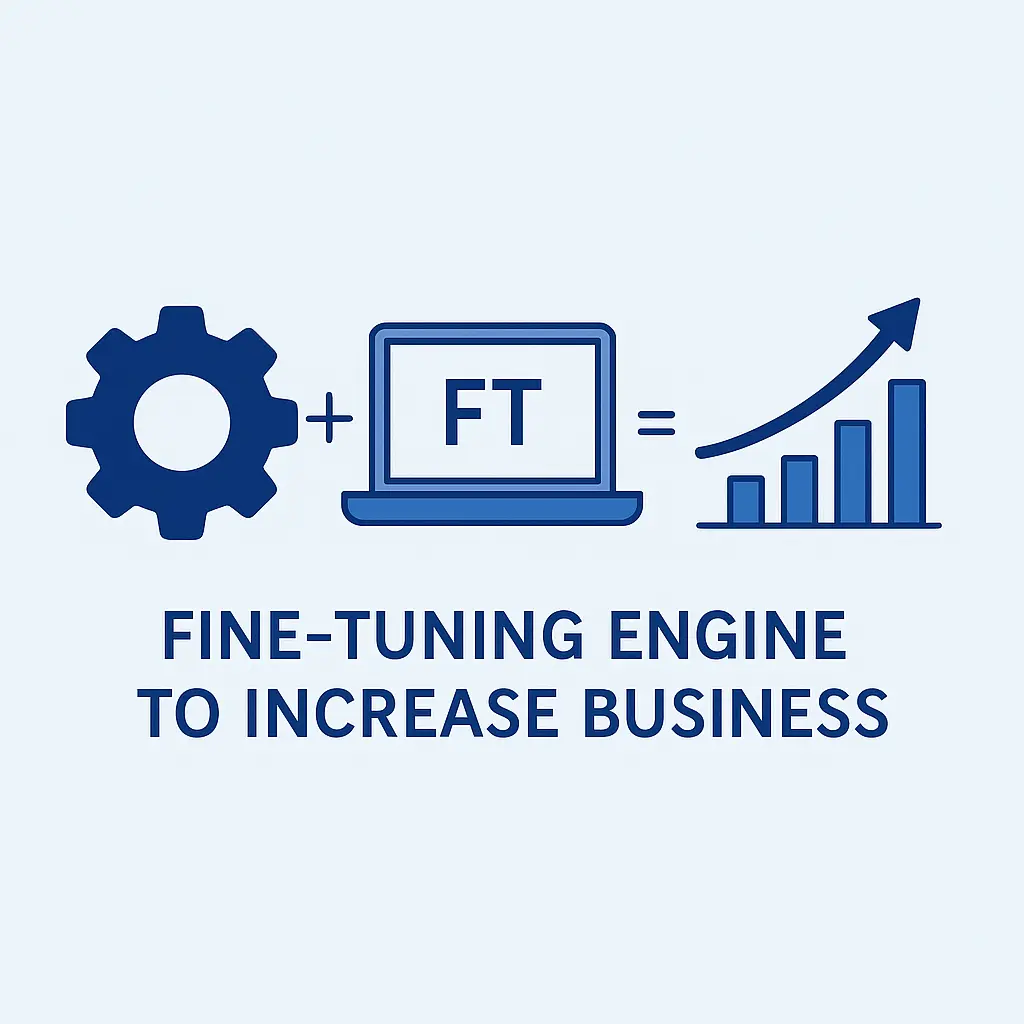
This is exactly what fine-tuning achieves.
By training a model directly on your company’s own documents, procedures, and database structures, you can transform generic AI into a domain-specific intelligence layer capable of reasoning within your operational reality.
What Fine-Tuning Really Means
Fine-tuning is the process of adapting a pre-trained language model (like GPT-5 or Llama 3) using your organization’s proprietary data.
Instead of retraining from scratch, you build upon the model’s general capabilities — grammar, logic, reasoning — and align it with your internal terminology, workflows, and decision logic.
For example:
- A general AI may not understand what “OC WMS Lot Expiration Rule” means.
- A fine-tuned model trained on your Oracle documentation, tax procedures, and SOPs will not only recognize it but respond with contextual precision.
Fine-tuning makes the model fluent in your company’s language.
Why Fine-Tuning on Business Data Matters
Enterprises generate vast amounts of structured and unstructured data — invoices, purchase orders, contracts, tax reports, item catalogs, supplier records, and so on.
However, traditional AI models don’t automatically understand your domain’s logic or abbreviations.
By fine-tuning on your real data and documents, the model learns:
- Specific field names and relationships (e.g., PO_HEADERS_ALL to AP_INVOICES_ALL)
- Internal terminology and acronyms (e.g., “RI reversal,” “LPN,” “SPED EFD-Reinf”)
- Tax and regulatory nuances unique to your country or sector
- Tone, style, and structure of your corporate communication
The result: a model that thinks and writes like your business operates.
How Fine-Tuning Works in Practice
- Data CurationThe first step is identifying high-quality, representative data.This includes procedure manuals, ERP extracts, spreadsheets, configuration documents, and resolved support tickets.The goal is to cover how your business actually operates.
- Preprocessing and AnnotationThe data is cleaned, anonymized, and segmented into examples that teach the model your structure.For instance:
- Input: “How to reverse a receiving transaction?”
- Output: “Use the Oracle R12 form ‘Receiving Transactions Summary’ and select Action → Reverse.”
- Model TrainingThe AI model is fine-tuned with these examples, reinforcing your patterns and domain logic.Parameters are adjusted to optimize both accuracy and style.
- Evaluation and TestingThe fine-tuned model is tested using real queries from your teams — operational, fiscal, technical — and refined based on feedback.
- Deployment and IntegrationThe trained model can be integrated with internal systems: chatbots, Oracle Cloud, analytics dashboards, or even RAG pipelines for dynamic retrieval.
Fine-Tuning vs. RAG vs. Knowledge Graphs
Each technology has a role:
| Approach | Strength | Ideal Use Case |
|---|---|---|
| Fine-Tuning | Deeply understands your domain language and internal logic | Standardizing tone, terminology, and reasoning across teams |
| RAG (Retrieval-Augmented Generation) | Dynamically accesses the latest documents and data | Real-time question answering with source traceability |
| Knowledge Graphs | Maps relationships between entities and systems | Contextual reasoning across ERP, CRM, and documents |
The best solutions combine all three:
Fine-tuning for fluency, RAG for freshness, and Knowledge Graphs for connections.
Real Examples of Fine-Tuning Applications
1. Finance and Accounting
A fine-tuned model can explain your company’s CNAB layout, identify retention tax rules, or generate SPED configurations automatically in your internal format.
2. Supply Chain and Logistics
It can generate reports or label templates directly from ERP data, or answer:
“List all lots expiring in 30 days for finished goods in organization 100.”
3. Procurement and Legal
By learning from past contracts, the model can recommend clauses, detect missing compliance terms, or summarize deviations from company policy.
4. Support and Knowledge Management
Fine-tuned assistants can respond exactly like your internal specialists — consistent, compliant, and traceable — even to complex technical questions.
Integration with Enterprise Systems
Fine-tuning can be applied using data from:
- Oracle EBS / Cloud ERP
- SAP, Dynamics, or TOTVS
- Databases (Oracle, SQL Server, PostgreSQL)
- SharePoint or internal document servers
- BI tools like OAS or Power BI
With proper data governance, the model learns securely without exposing sensitive information outside your environment.
Business Impact and ROI
Fine-tuning leads to measurable outcomes:
- 70–90% faster response time in internal queries
- Consistent knowledge application across departments
- Reduction of manual training hours for new employees
- Improved compliance through standardized communication
- Better decision support, powered by models that understand your data natively
This is not just automation — it’s knowledge institutionalization.
Governance, Security, and Privacy
Fine-tuning is done within strict governance frameworks:
- Sensitive data is anonymized and encrypted
- Models can be hosted on-premises or in secure private clouds
- Access is controlled by roles and policies
- Every response can be logged and audited for compliance
With proper setup, fine-tuning aligns fully with LGPD and ISO 27001 standards.
The Future of Business Intelligence
Fine-tuned models are the foundation of the next generation of enterprise intelligence — systems that don’t just process data, but understand your company’s logic, terminology, and regulations.
The result is an AI that speaks your organization’s language fluently, supports decision-making with context, and bridges the gap between technical data and business outcomes.
Final Thoughts
Fine-tuning is how you turn AI from a general assistant into your company’s own expert.
It learns your workflows, your rules, your documents — and delivers responses that make sense in your reality.
Your data already holds the knowledge.
Fine-tuning transforms it into understanding.