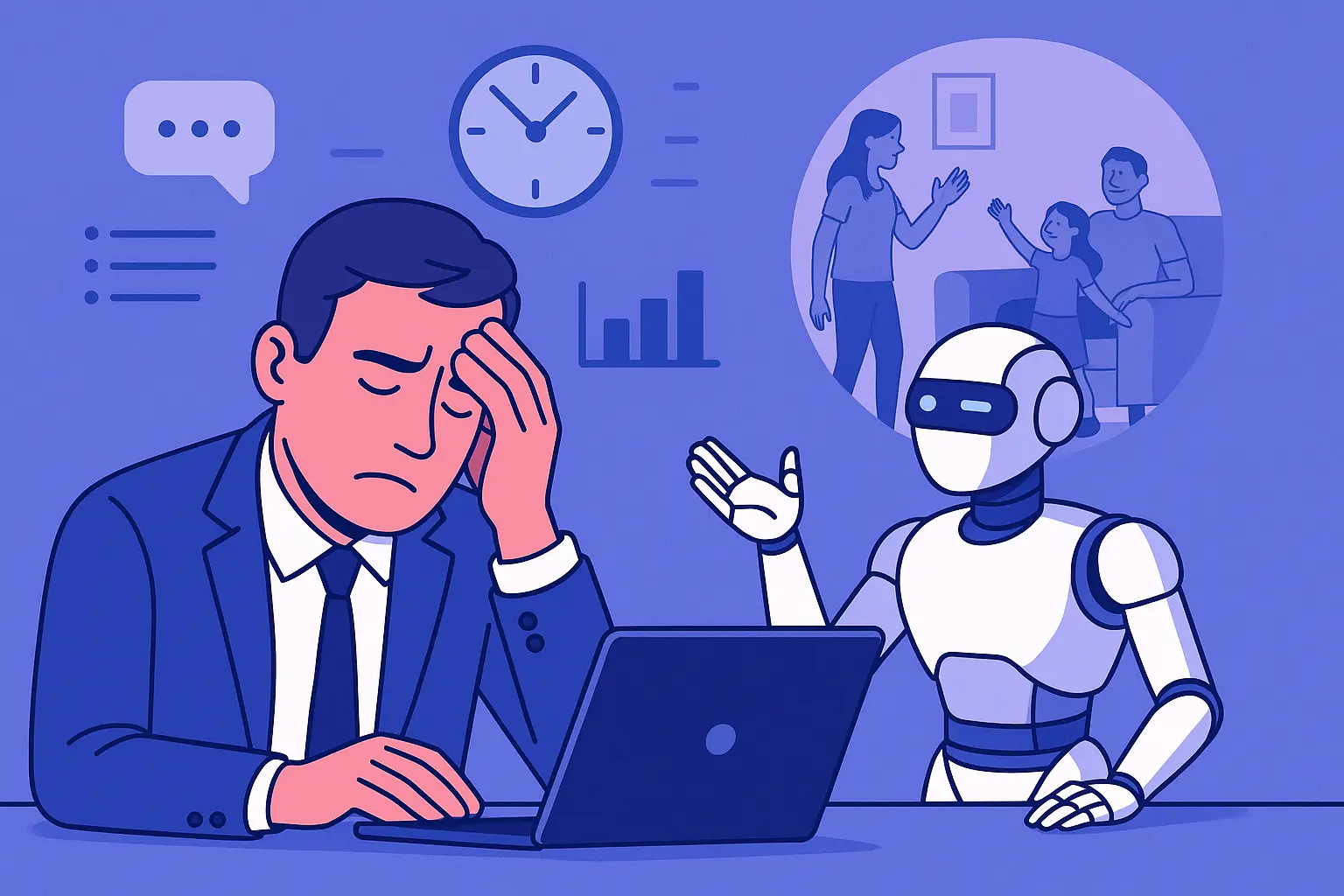
The promise seemed clear: with the rise of Artificial Intelligence, we would work less, automate repetitive tasks, boost productivity and finally have more time for family, leisure and mental health.
But for many people, reality has been exactly the opposite:
- more meetings
- more demands
- more pressure for results
- and less free time
Where did this equation start to go wrong?
The promise: automate the boring, free the human
When we talk about AI at work, the most common narrative is:
“The machine does the operational work, humans focus on the strategic.”
In theory, this means:
- fewer hours on manual, repetitive tasks
- less rework
- less time spent “formatting” things
- more focus on creativity, relationships, decision-making and innovation
In other words, a reduction in time-stealing workload and an increase in the value generated per hour worked.
Except… that’s not exactly what happened.
The reality: productivity became more pressure
What many professionals are feeling is that AI hasn’t reduced workload; it has simply increased expectations.
- If you used to deliver 3 items per week, now, with AI, they expect you to deliver 8.
- If errors and rework used to be “part of the process,” now, with smart tools, “you’re not supposed to make mistakes anymore.”
- If an analysis used to take 2 days, now they want it in 2 hours.
In many companies, a silent shift has taken place:
AI didn’t come to shorten the workday — it came to raise the bar for what is considered the “minimum acceptable.”
Technology speeds things up, but the work culture has not been redesigned along with it.
The paradox: more tools, less time
We are surrounded by so-called time-saving tools:
- AI assistants
- automations
- dashboards
- bots
- prebuilt models, templates, copilots
In practice, this creates three side effects:
1. Hyper-availability
“If everything is faster, why haven’t you replied yet?”
- Messages coming in from every channel (email, Teams, WhatsApp, etc.)
- An expectation of almost immediate responses
- The erosion of clear boundaries between “work hours” and “personal time”
2. Role stacking
AI “helps” design slides, write texts, review contracts, build dashboards…
Suddenly, one person is doing the work of two or three roles, under the illusion that “AI is helping, so it’s fine.”
3. Acceleration without direction
We do more things, faster — but not always the right things.
Productivity increases, but not necessarily quality of life, nor the meaning we find in our work.
The cultural factor: it’s not
just
about technology
The root problem isn’t only AI, but how organizations and leaders define productivity.
Instead of asking:
- “How can AI allow us to work less and better?”
The implicit question is often:
- “How can AI make the team deliver more with the same number of people (or even fewer)?”
Without a mindset shift, every technological gain turns into:
- more targets
- more reports
- more controls
- more deliveries per week
In other words: humans have been plugged into a faster conveyor belt, with no right to pause.
The invisible cost: mental health, creativity and relationships
This chronic overload has a price:
- rising anxiety and a constant sense of inadequacy (“I can never keep up”)
- difficulty disconnecting after hours
- less quality time with family, friends and hobbies
- less mental space to think calmly, create and learn in depth
The irony is harsh:
AI is excellent at producing things at high speed.
But what gives life its meaning — relationships, presence, calm, reflection — still requires human time: slow, non-automatable time.
Possible paths: how to change the game
The situation is not inevitable. The question is how we choose to use AI.
Some shifts in attitude (both individual and organizational) can help.
1. Redefine what “productivity” means
Productivity cannot be just “doing more things in the same day.”
It needs to account for:
- long-term sustainability
- quality of work
- real impact (not just volume)
- mental health and work-life balance
2. Use AI to remove unnecessary work
Instead of just speeding everything up, we should ask:
- What can be simplified or eliminated?
- Which reports, requests and bureaucracies exist merely “because that’s how we’ve always done it”?
- What kind of task could cease to exist altogether if we redesigned the process?
3. Protect interruption-free time
Even in a world full of AI and notifications, we need:
- blocks of deep work (without a new ping every two minutes)
- times of day when it’s acceptable not to answer right away
- clear communication agreements with teams and leaders
4. Turn efficiency gains into free time
This is the hardest — and rarest — part.
Whenever a team becomes more efficient with AI, one question should be asked:
“What will we do with the time we’ve gained?”
Possible answers:
- More projects and more pressure?
- Or a bit of breathing room, more planning, more learning, more balance?
Without a conscious decision, the system automatically pushes toward more load.
Conclusion: the choice that comes with power
One sentence sums up the paradox:
AI arrived promising we would work less and have more time for our families, but in practice we are increasingly overloaded and with less free time.
Technology itself is neither villain nor savior.
It is an amplifier: it accelerates whatever the culture already does.
If the culture is one of:
- constant urgency
- glorifying a packed schedule
- endless targets
- lack of clear boundaries
Then AI will amplify all of that.
But if we start using AI guided by a different question —
“How can it help us live better, not just produce more?” —
then the old promise might, at last, begin to come true.
We won’t get an AI that magically hands us back our time.